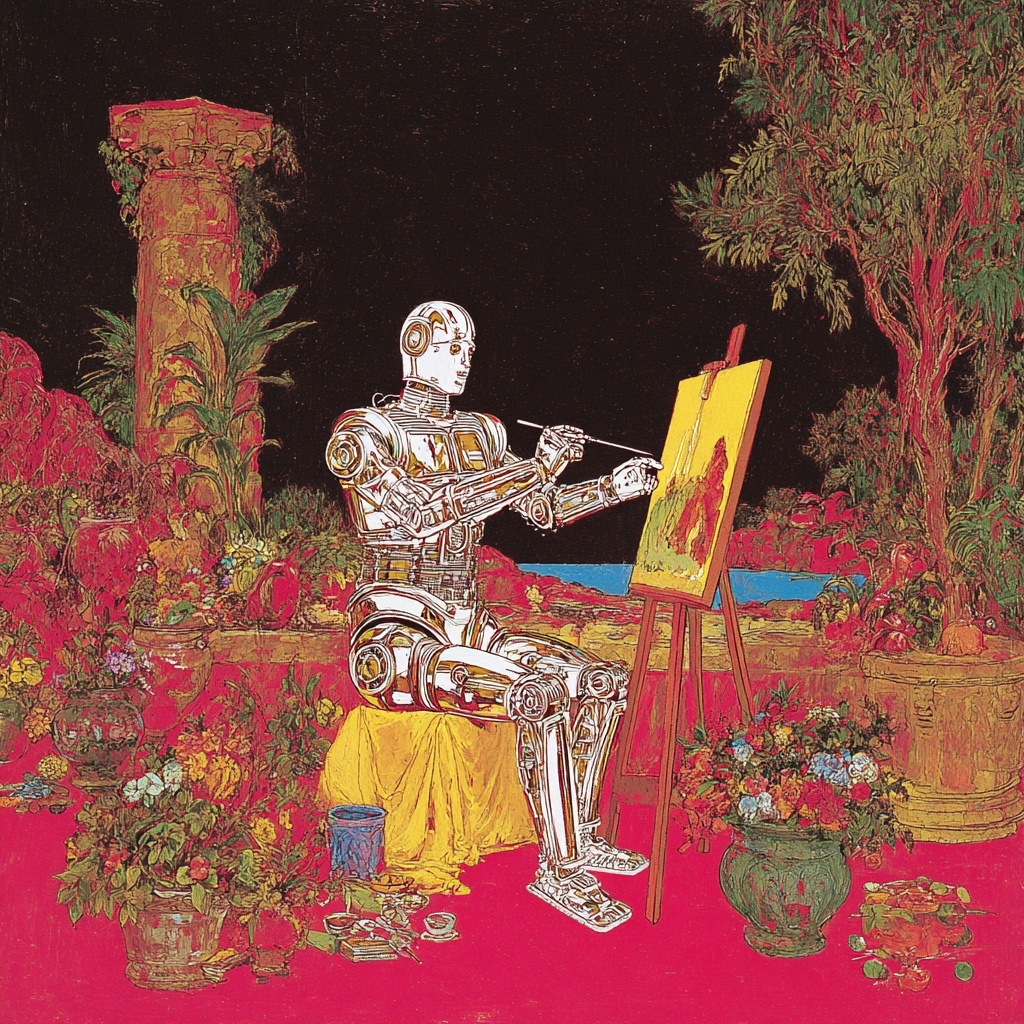
AI gave everyone a generative engine. It also revealed who had nothing to say.
February 11, 202610 min read
In 1884, Joris-Karl Huysmans published À rebours (Against Nature or Against the Grain), a novel about a man with perfect taste and no life. Des Esseintes, the last scion of a decaying aristocratic family, retreats from Paris to his country estate where he devotes his time entirely to aesthetic refinement. He becomes nocturnal in order to avoid human contact altogether. He builds a mouth organ that dispenses liqueurs in harmonic combinations. He cultivates poisonous flowers. He buys a live tortoise and encrusts it with precious jewels. The poor creature is slowly crushed to death under the weight of the gemstones.
Des Esseintes is the first tech founder.
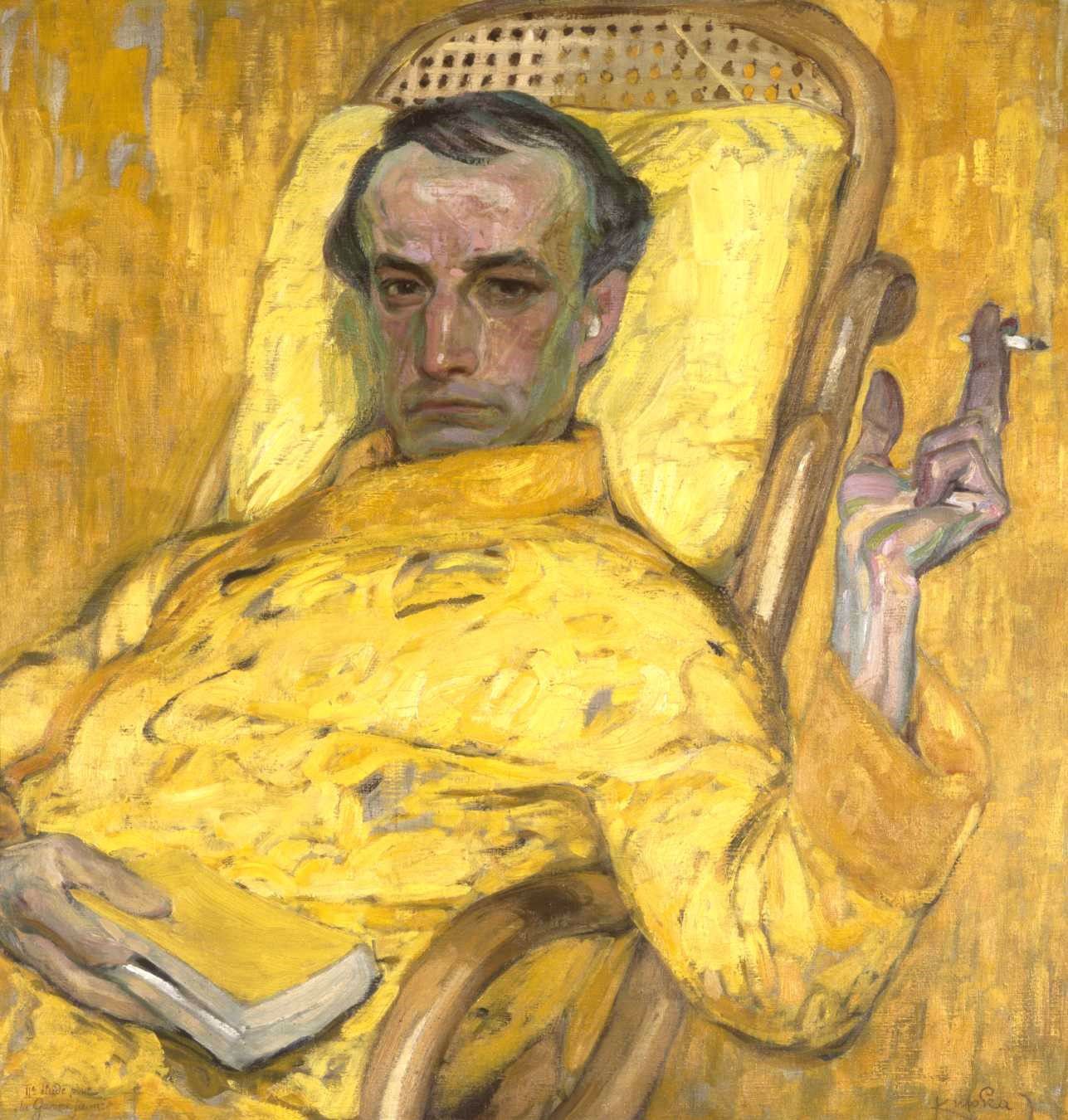
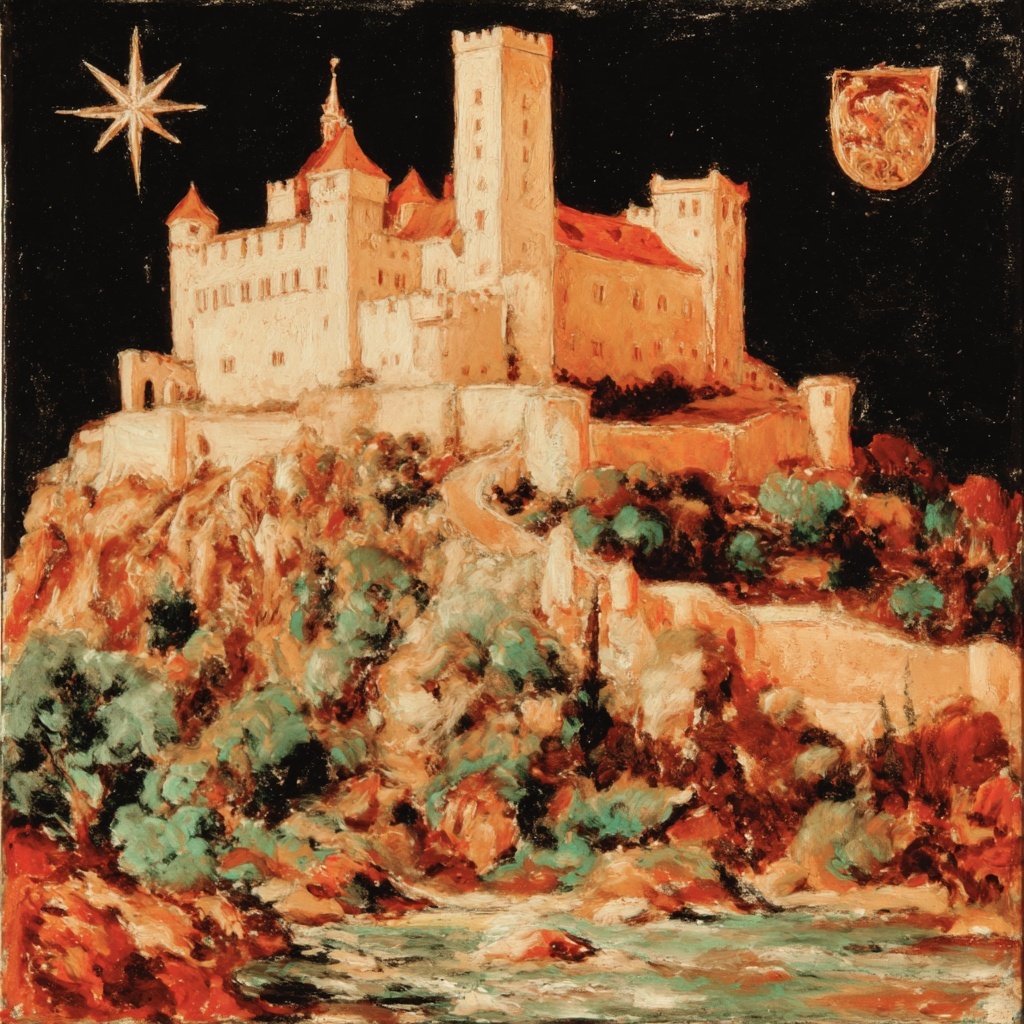
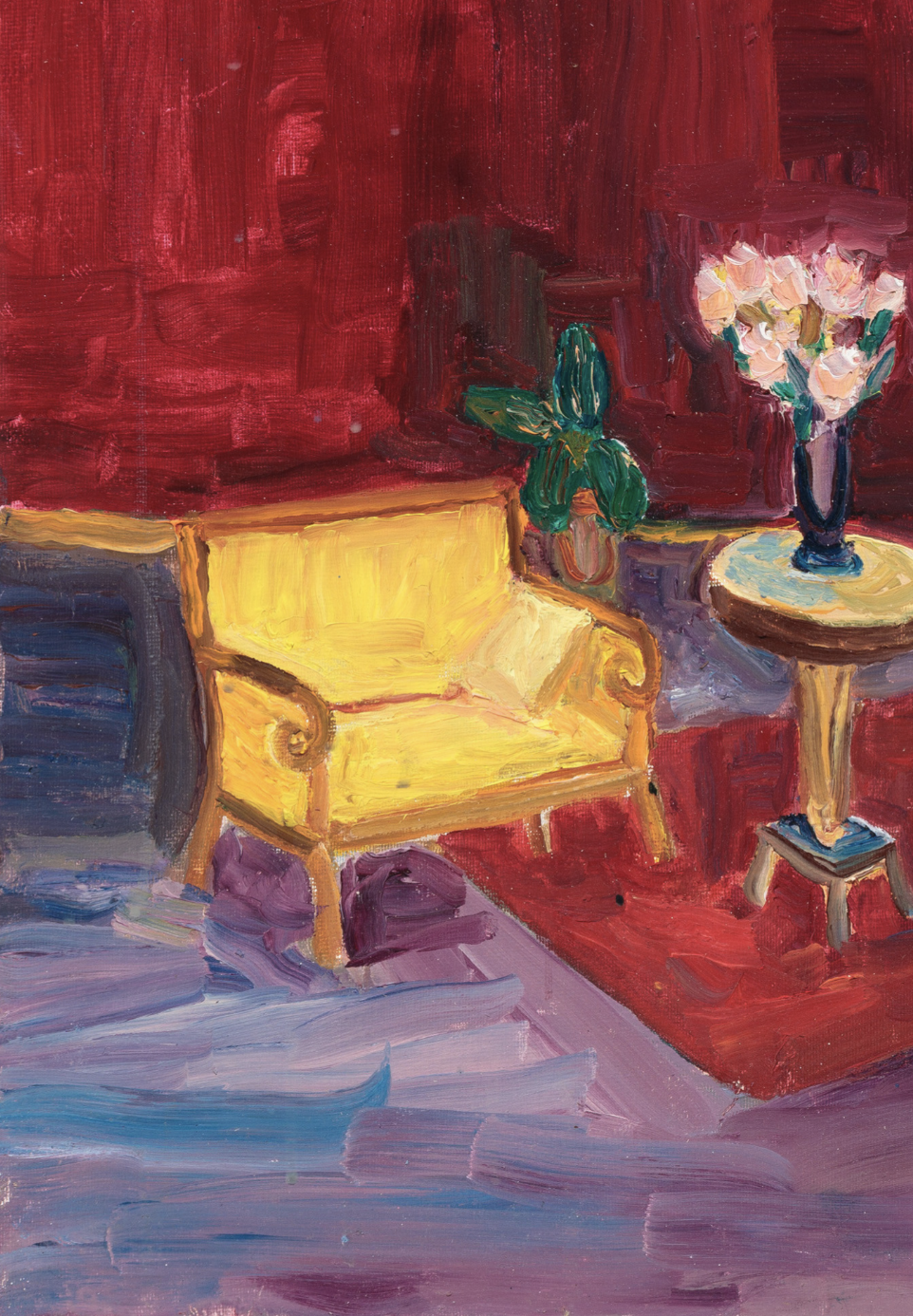
František Kupka.The Yellow Scale(1907). Oil on canvas.
He edits brilliantly. He selects impeccably. His references? Exquisite. His vision? Obsessive and singular. Yet he produces nothing, and eventually goes insane (or converts to Catholicism, these are the only two options in Decadent literature…but I digress). His taste is a closed system: all input, no output. A consumption engine so well-curated it collapses like his pet reptile from its own pursuit of perfection. Huysmans understood, 140 years ago, that a taste level which only consumes eventually consumes itself. The book was Oscar Wilde's favorite. It even makes a cameo in The Picture of Dorian Gray, another foreboding tale about vanity and artifice. Accidentally, it's the most accurate portrait of Silicon Valley's relationship to aesthetics ever written. It explains why everything AI generates looks the same. Why we call software products things like "artifacts" and "codex." And why the people with the most powerful creative tools in history keep making the same Dieter Rams knockoffs over and over again.
Anodized
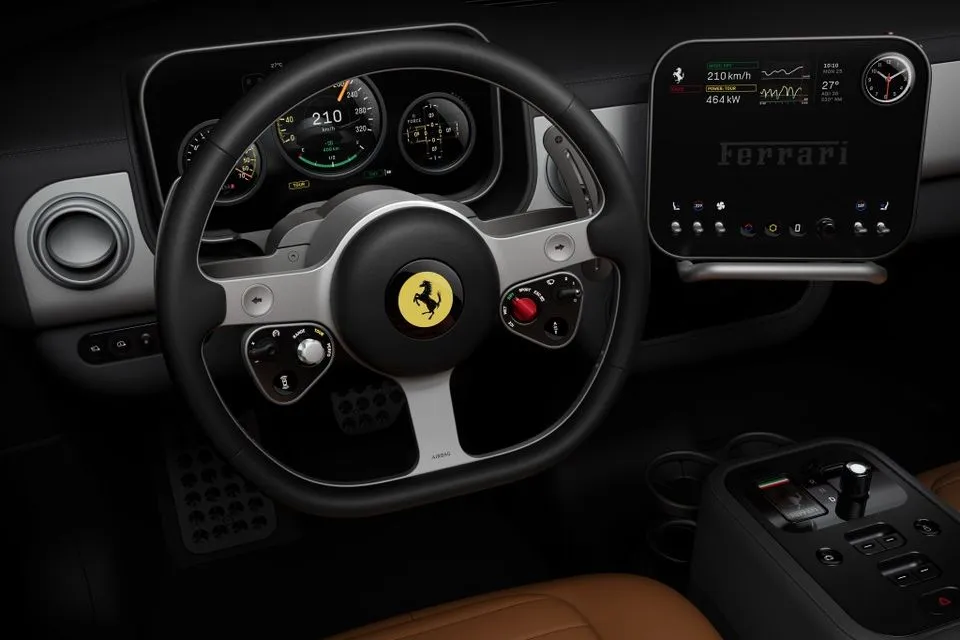
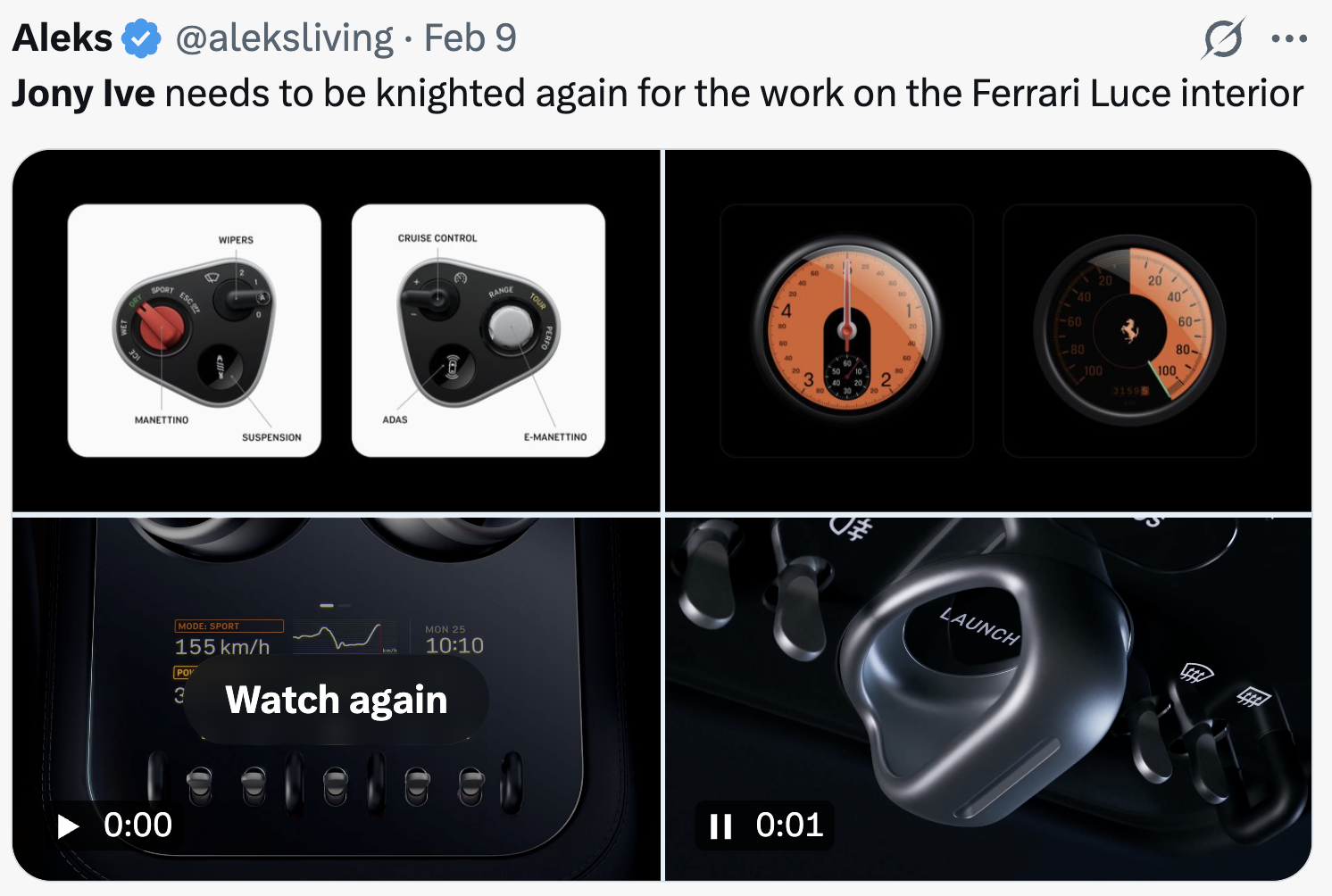
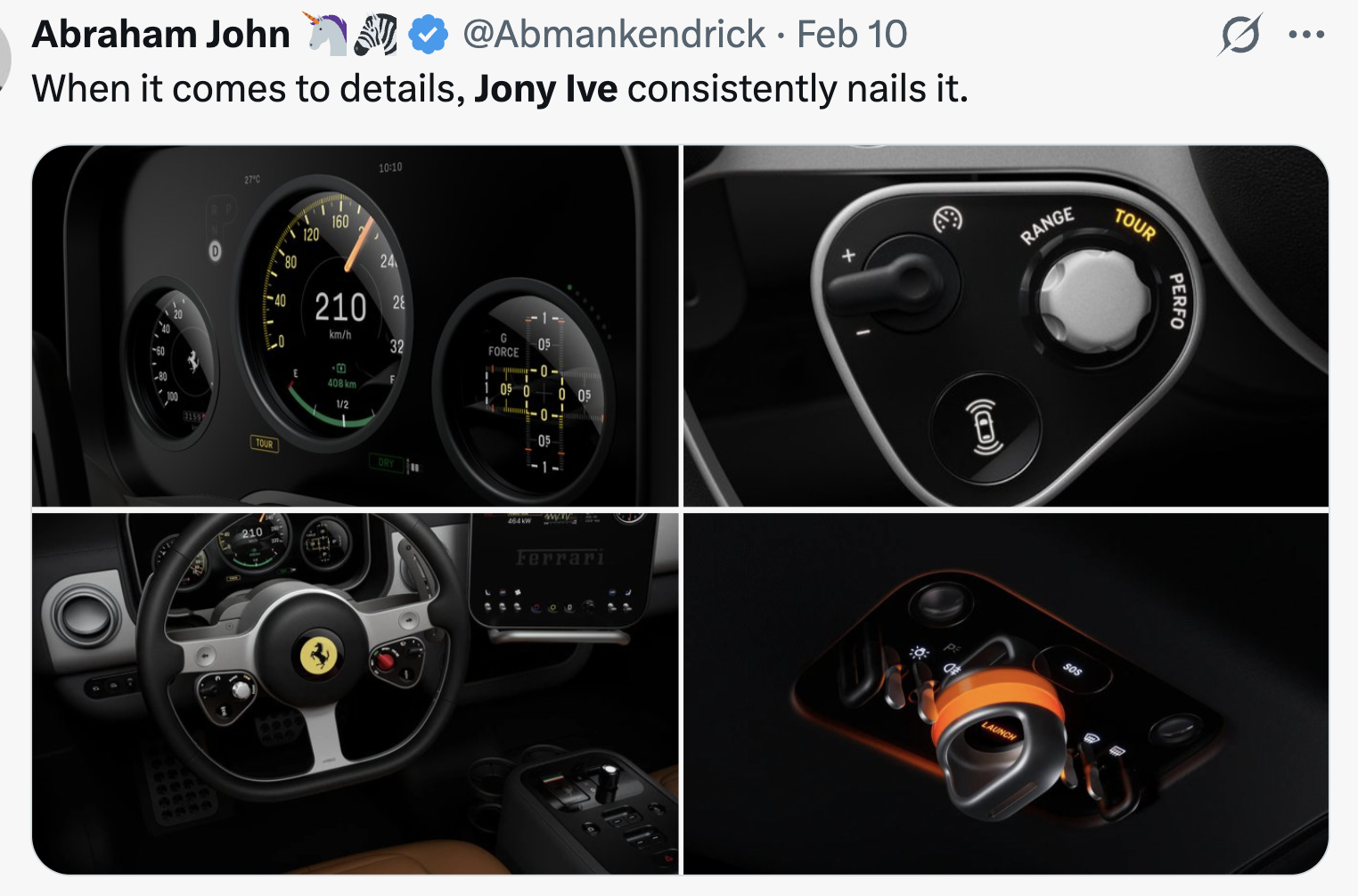
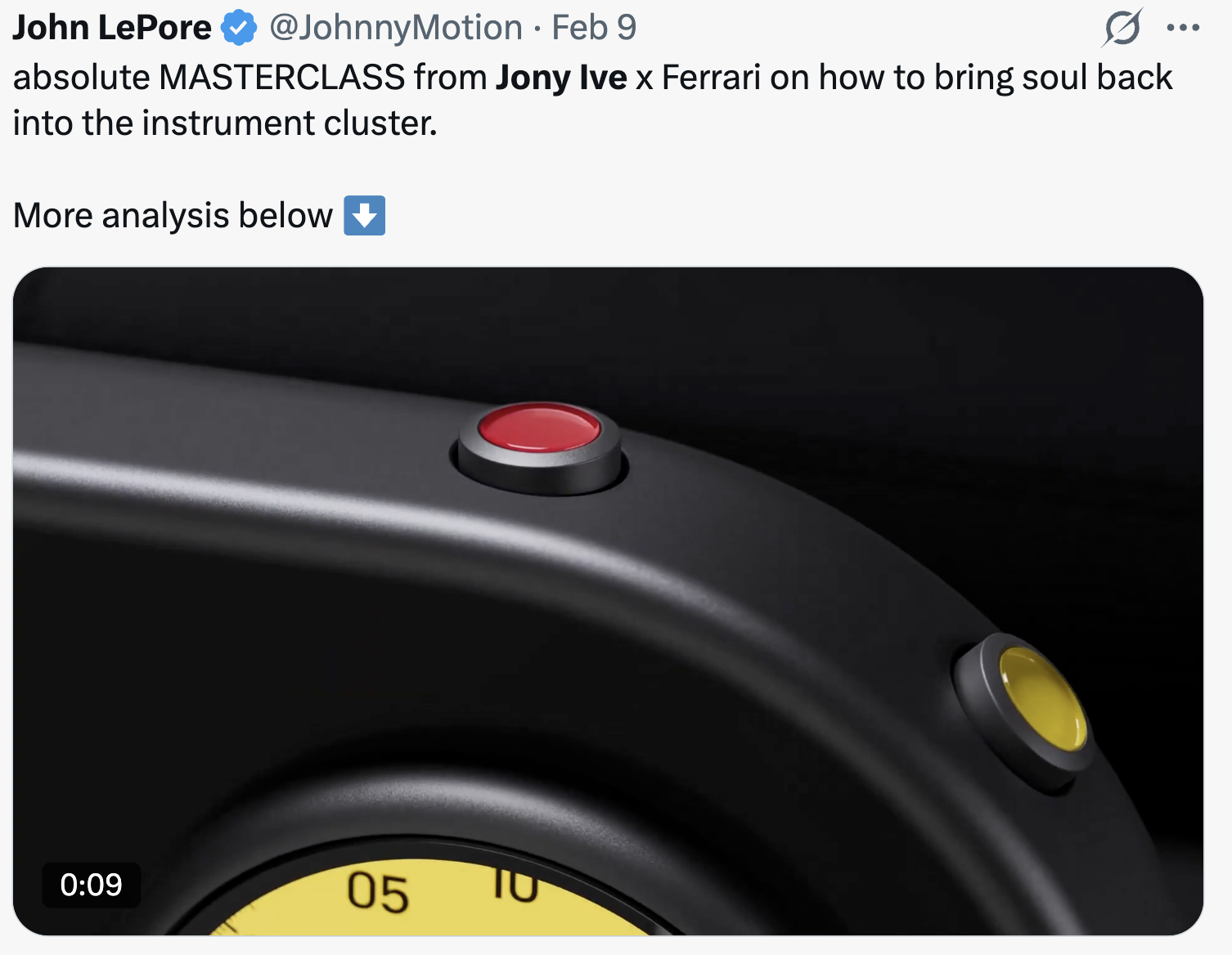
A few days ago, Jony Ive unveiled the interior of the Ferrari Luce, the prancing horse's first electric car. The tech design community immediately praised him as a living God. He's "done it again!" He's "nailed it." He "needs to be Knighted" for the work. It looks like a giant Apple Watch.
The Ferrari Luce's Jony Ive-designed UX and display system is…just another Braun clock.
Squircles. Gorilla Glass. Milled aluminum. Anodized everything. Hacker News, unexpectedly, actually nails it: "If you phone up Jony Ive you'll get a slapdash re-run of 2010s iPhone design." Ive spent five years with a company whose 1960s cockpits were so raw and evocative they made your hands shake. And the output is an extremely generic consumer electronics interface bolted inside a half a million dollar car.
Ive is the most celebrated industrial designer alive. He's also the most advanced Des Esseintes in history. A man so deep inside his own aesthetic system that he can no longer see outside of it. The savvy critics see his post-Apple work for what it is: a guy encrusting a tortoise with jewels.
This is what happens when you mistake having taste for having style. And it's endemic. Half of Silicon Valley talks about taste now the way sommelier hobbyists talk about terroir: with enormous confidence, zero productive capacity, and the unmistakable pleasure of smelling their own farts. They think having taste means knowing the right references and owning a Noguchi lamp. It doesn't. Taste, real taste, has always been a darkly contrarian impulse. The private compulsion to push on reality in ways that delight you before you can explain why. The people who actually had it were almost never the ones talking about it. But we live in an era where every founder who hired a junior designer with a Figma account thinks they've found the next Steve Jobs. So, if these people are tasteless, it's worth asking what taste actually is. Luckily, an Italian philosopher figured this out for us half a century ago.
Mucho Gusto
In 1979 Giorgio Agamben published an essay called Gusto (Taste) that I would bet almost nobody in Palo Alto has read. His argument is that taste is not a way of knowing beauty, but rather the place where cognition and desire meet and fail to resolve. Taste is "a knowledge that is not known and a pleasure that is not enjoyed." It doesn't close. It doesn't decide. It sits in the gap. Uncomfortably. This is why people with taste almost always have a distinct, stylistic view of the world and also spend much of their time interrogating it. They are anxious and ever-churning. They doubt themselves constantly. Yet they also know what they like, even if they don't know why. Agamben is talking about the literal sense of taste, which he argues is our least-heralded compared to romantic standards like sight and touch. But he's also talking about taste in the broader cultural meaning of the word. He doesn't feel the need to distinguish between the two, ironically, because he has taste.
"Taste is a knowledge that is not known and a pleasure that is not enjoyed."
Silicon Valley, brand designers and "creative directors" in general today use "taste" to mean the opposite of Agamben's definition. To them, it's a decisive selection. A solution, even. The right typeface. The correct palette. The confident click. Something that can be monetized because people like it. But the moment taste resolves into a system like this, it stops being taste and starts being fashion. And fashion, as Glenn O'Brien (someone with a very high taste level) spent his career insisting, is what makes you the same as everyone else.
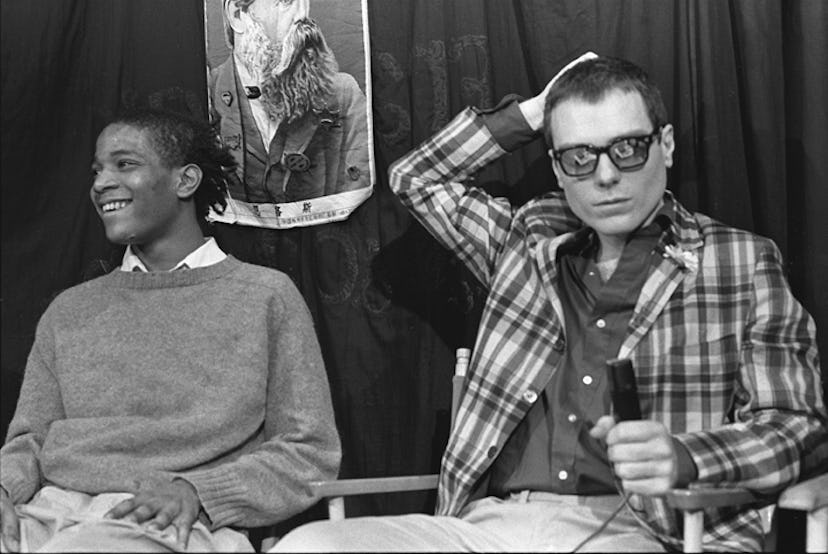
O'Brien and Basquiat on his Public Access Television show TV PARTY. The manifesto: TV PARTY is the TELEVISION SHOW that's a COCKTAIL PARTY but which is also a POLITICAL PARTY. Why not? Taste doesn't need to make sense.
Enfant Terrible
Essays on commerce, culture, and the art of ideas.
Taste is discovery. Taste is editing. Taste is the long, private, often embarrassing process of figuring out what you actually like, as opposed to what you've been trained to approve of. It requires getting it wrong, a lot. Wearing something ugly. Loving the work of art all your friends hate. Sitting with a piece of music that makes no sense until, three years later, it suddenly does. Taste is accumulated through contact with the world, not through the production of moodboards.
Des Esseintes never left his house. Neither, aesthetically speaking, has most of the tech industry. They've replaced the embarrassing, self-searching, experimental part with the collecting part. Which is like replacing physical therapy with crutches.
Rick Rubin Isn't Being Serious
Rick Rubin says artists pay him simply for his taste. This has become a viral refrain. He's obviously joking, for Christ's sake. Rubin has 40 years of sitting in rooms with the world's most talented people, listening, failing, and recalibrating across every genre imaginable. That's not his taste level. That's scar tissue and intuition. It's experience and skill. But now all the founders read The Creative Act, and all the VCs listen to Tetragrammaton, and a generation of people who've never sat with anything longer than a sprint cycle think they can reference their way into Rubin's hemisphere.
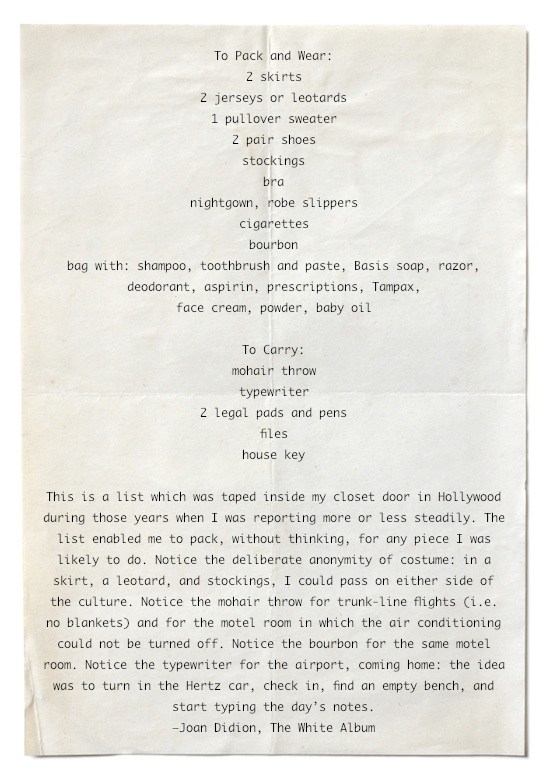
You can't. And you shouldn't want to. Glenn O'Brien didn't. And neither did Martin Margiela, or Joan Didion, or Alexander McQueen, or Alejandro Jodorowsky for that matter. They all had something better: points of view so specific they couldn't be borrowed. O'Brien founded Andy Warhol's Interview, bought Basquiat's first painting, directed ads for Barneys, and wrote GQ's "The Style Guy" column for 15 years. When he smoked too much weed and fled his role running (ironically) High Times magazine, he invented the term "editor-at-large." When GQ replaced him with a vapid millennial, he told them to call his successor "The Style Intern." Margiela never showed his face. He spent 20 years as fashion's most influential designer, responsible not only for his cult-status eponymous line but also for stewarding Hermès into their modern era of massive profitability. And you couldn't pick him out of a lineup. Didion wrote a packing list in The White Album that tells you more about how she sees the world than most designers' entire portfolios. A self-portrait in objects. McQueen made people physically sick at his shows, on purpose. Jodorowsky spent two years building a version of Dune that was never filmed, and it influenced every single sci-fi movie that followed anyway, plus Virgil Abloh and so many more "tastemakers" of the modern era.
Didion's packing list.
None of these people were curating. They were imposing. A curator selects from what exists. A point of view generates things that didn't exist before, and makes you uneasy about why you like them. Critics hated most of these people when they first hit the scene. Today every 20-something creative walking through Williamsburg is a mini-Didion and every 30-something art director a faux-O'Brien, whether they know it or not. That's what a point of view does - it becomes the weather. Jony Ive would never want to make you uncomfortable. He disdains friction. That's his ceiling, and it's forgettable. Yet the really interesting question here isn't who has taste and who doesn't. It's what happens when access stops serving as a bottleneck, and taste is all we have left?
Chopsticks
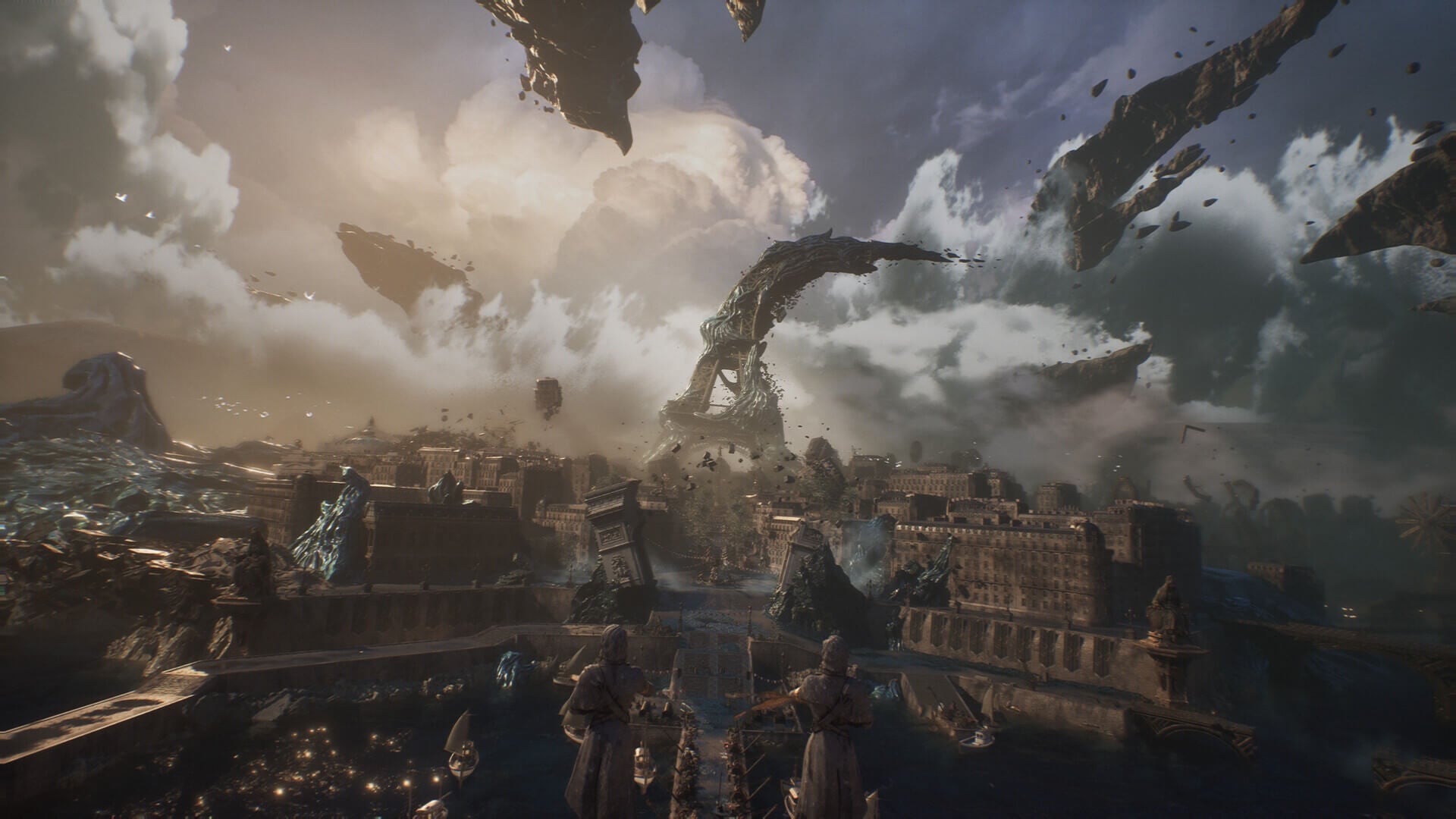
A style frame fromClair Obscur: Expedition 33featuring a melting Tour d'Eiffel.
The mainstream conversation about AI and taste is boring. Can machines even have taste? Will AI replace creativity? Is generative art real art? These are À rebours questions. Consumption and curation. They miss the point entirely.
What is actually happening is obvious, and painfully human. We gave the world a generative engine for taste and 99% of companies, brands, and people produced slop with it. Then we blamed the engine. This is like handing someone a Steinway and cursing the piano when they play "Chopsticks." AI didn't create slop. It merely revealed that most of the people who claimed to have a taste level were actually just good at moodboarding and copying Dieter Rams. The moment they had to generate instead of curate, the emptiness was right there on the screen. And it stung.
This was Huysmans' point. Taste that only consumes produces nothing when you finally ask it to create. We've established that real taste is tied to a personal point of view. Well, the one prerequisite for having a point of view is having a life. Not a reference library. A 30-person video game studio in Montpellier, France proved this last year and won Game of the Year doing it. They also used AI to help.
Sandfall Interactive was founded by a group of mainly junior developers on their first production. Their first project was led by an art director whose previous job was designing Cirque du Soleil sets and a musical director they found on an internet forum. Together, they built Clair Obscur: Expedition 33, a Belle Époque turn-based RPG pulling from Bosch, Beksiński, and Baudelaire as much as Final Fantasy. The game's design team described their process as "draw stuff we think is cool." As a result, Clair Obscur looks like nothing else in games. The narrative is the best story I've seen on any screen in years. The score is so good it has over 320 million streams on Spotify as of February 2026. It won more Game of the Year awards than any video game in history and sold over five million copies. Most impressively, and controversially to some of the nerds in video game journalism, Clair Obscur was built with the help of AI. Sandfall's developers took a mass of tools and technologies that didn't exist five years ago and brought their vision to life with the full artistic determination it required and on a timeline the market demands. Some people begrudge them for this. Those people have no vision. And bad taste.
For those with taste, AI is extraordinary. Runway, a generative AI startup valued at $5.3 billion, is building what they call General World Models. These are systems that generate coherent, physics-aware, navigable environments in real time. Not renderings. Not game levels. Proposed alternate realities. You give it a scene and it gives you back a world replete with consistent geometry, reactive lighting, and functional physics. But it's still up to you to fill it with characters. The applications of technology like this span the horizon from content production (the company famously collaborated on A24's Everything Everywhere All at Once) to robotics, where "GWMs" can train machines to navigate physical environments they've never encountered, or might not even exist yet.
One common way people describe this is as "simulation technology." That's too small-minded. The Matrix is just another useful reference for technologists and dystopians alike. What companies like Runway are building is an infrastructure for externalizing a point of view at full resolution. Every aesthetic decision happens at once: how light behaves, how space unfolds, what exists, what doesn't. Everything short of scent and touch. A world model doesn't pick a font. It proposes a reality. Yet to do that and still make it interesting, you need a life full of experiences and the right collaborators to achieve excellence.
The finest creative confederates of the future might just be AI. Good. They don't have egos and they don't take equity. Jodorowsky had to seek out Giger, Moebius, Dalí, and Mick Jagger to design a world that was never even born. Yet it restructured an entire genre anyway. Now any person with a genuine point of view and a world-model engine could theoretically do the same by themselves. This used to require a major studio or a Renaissance patron. Today it requires a subscription.
The question is whether the people building these tools understand what they've done. This is not productivity software. It's not a better Photoshop. It's a potential amplifier for the gap Agamben identified — the space between knowing and feeling. The place taste actually lives.
Some people will use it to encrust more tortoises. More muted tones, more Bauhaus boredom, more consensus dressed as prophetic vision. Silicon Valley, in particular, is at major risk of falling into this trap. But the people who've actually bled for a point of view now have a medium that can hold the full dimensionality of how they think, see, and feel. That's a game changer.
The tastemakers: AI company logos that look like buttholes.
All this matters because the stakes are decidedly not aesthetic. They're civilizational. For the first time in history, the constraint on what gets built is not resources, nor distribution, nor technical capability. AI is dissolving all three simultaneously. The bottleneck is now taste itself. The limiting factor on what gets funded, what gets made, and what gets remembered is whether the person holding these new tools has anything worth saying with them at all. It's clear today that most don't. Yet.
We've spent the last 20 years promoting pattern-matchers, rewarding reference-collectors, and building an entire curatorial class whose philosophical capacity tops out at "frictionless design." But taste is abrasive, and rarer than ever. This should concern you more than any doomer scenario about artificial general intelligence enslaving the human race. We wonder why the culture is flat. Why we produce slop at work, eat slop bowls for lunch, and scroll through slop for leisure. The danger was never that the machines would develop taste. It's that the people directing them never had any in the first place.
Huysmans ends À rebours with our rakish, neurotic hero Des Esseintes forced back to Paris, his aesthetic fortress in ruins, faced with a choice between madness and faith. We have a third option now. Go make something.