Why every strategist is one prompt away from obsolescence.
February 23, 202610 min read
You probably read Cicero in High School, and you definitely read him if you went to Law School. He was a towering figure in history whose influence on politics and philosophy is felt to this day. In 44 BC he published a treatise I bet you have not read. De Divinatione concerned the Roman practice of reading the future in the guts of animals. This was such serious business that it even had a name and official job function: haruspicy. Sounds like a special at a sushi restaurant. Anyway, in the practice of haruspicy, a trained priest split open a sheep, examined the liver for abnormalities, and then pronounced what the gods intended.
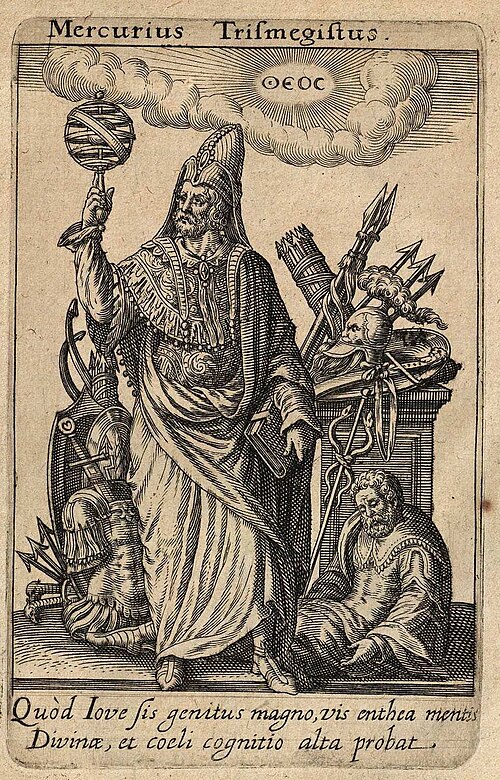
Mercurius Trismegistus, the legendary syncretic figure combining the Greek god Hermes and Egyptian god Thoth. Revered as the mythical founder of Hermeticism. OG strategy guy.
The Hermetic tradition, named for the mythical Egyptian priest Hermes Trismegistus, was built on an even more explicit version of the same principle. In Hermeticism, it’s imperative that “sacred knowledge” is sealed away from the unprepared (aka everyone). We still invoke The Magical Mister Trismegistus every time we describe something as “hermetically sealed.” The modern industry of strategy itself is hermetic in both senses.
The Etruscans systematized these traditions so rigorously that they even created carefully crafted bronze model livers divided into specific regions labeled with the names of deities, and used them as training aids. Armies marched on the readings. Emperors expedited or delayed decisions. The Roman Senate kept haruspices on retainer the way a Fortune 500 keeps McKinsey on speed-dial. And for the same reason too. Not because the readings were accurate, but because the institution required someone with the authority to convert uncertainty into what seemed like an informed expert recommendation.
Cicero, who had served as an augur himself, said the obvious part out loud: that no two haruspices could look at each other without laughing. They knew. The sheep couldn’t predict what it was going to eat for dinner, let alone could its internal organs foresee the future. The liver wasn’t a text that could be read. It was a liver. But the institutions needed someone to stand between the chaos of the world and the people with the authority to act in it, and that someone needed a title, a methodology, and the appearance of meticulous professionalism. The haruspex provided all three. The bronze liver was his framework. The examination was his process. The pronouncement was his deliverable. He was a strategist. And his fee was, of course, considerable.
The Etruscan Liver of Piacenza, circa ~100 BCE. It was discovered in 1877 by a farmer plowing his field in northern Italy.
I have been a strategist for 15 years. I have read the entrails of consumer segmentation studies, NPS scores, brand health trackers, social listening dashboards, industry trend reports, and copious amounts of moodboards. I have stood in rooms and pronounced meaning. I have been the haruspex. And I am here to tell you today what Cicero knew 2,000 years ago: the sheep don’t know shit.
The Interpretive Class
Every civilization produces a kind of priestly interpretive class. The pattern is so consistent it might be structural to organized human activity. They used to be called augurs or oracles or soothsayers. Today they’re called “strategists.”
When the laws became too complex for ordinary citizens to navigate, lawyers appeared. When knowledge of the body became too overwhelmingly specialized, doctoring emerged from barbering (a split that took roughly four centuries in Europe, during which your surgeon and your haircutter were the same man, and the red-and-white barber pole still commemorates the blood and bandages of that original dual practice). When financial instruments became too abstract for even the people trading them to explain, analysts swooped in to save the day. And perhaps most nefariously, when markets became too diffuse for a single executive team to comprehend, management consultants reared their ugly heads.
The interpretive class always works the same way. First, they guard something you can’t read on your own. Sometimes the complexity is real — case law is genuinely impenetrable. Sometimes it’s invented — your consumer is not actually that mysterious, but a $40 billion research industry depends on treating her as if she is. Second, they need to keep it unreadable. The medieval Church conducted services in Latin not because God speaks Latin, but because a congregation that could understand the text directly would no longer need a priest to explain it. Third, they produce artifacts that look like knowledge but function as ritual objects. The diagnostic report. The legal brief. The political poll. The customer analysis. The strategy.
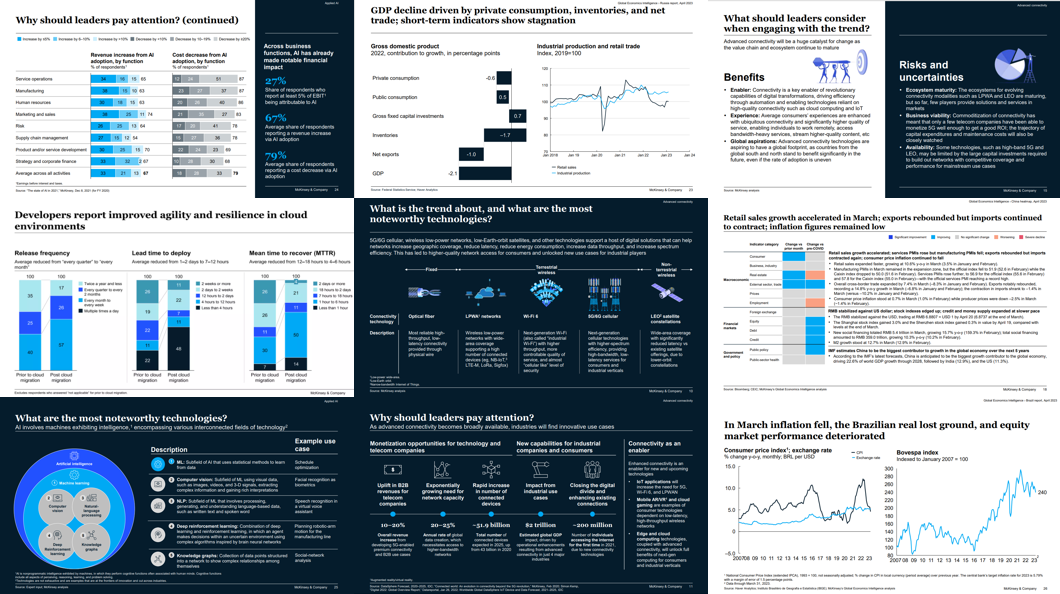
Some McKinsey slides. Strategy as liturgy.
That last point is important. The strategist’s primary artifact is a fucking deck. A form that emerged from an overhead projector in the 1960s has now metastasized through PowerPoint in the 1990s into the dominant liturgical text of the modern knowledge economy. The deck is doctrine. Hallowed and pristine. The output that proves a strategist has done the sacred work of interpretation. 5 slides. 50 slides. 150 slides. It makes no difference. There’s a framework here. A consumer segmentation there. Charts. Oh, are there charts! A “strategic territory” brings all this very serious data into clear view. Now a vision is beginning to crystalize. And the client loves it, because it was designed to make them love it. There are also a lot of words. Words like “permission” and “tension” and “culture” and “action plan” and “white space” and “deliverables.” Acronyms abound. The deck is the scripture. The tissue session is the service. The almighty “insight” is the sermon.
Enfant Terrible
Essays on commerce, culture, and the art of ideas.
I don’t mean this metaphorically. When you strip the business language from what a strategy department or a management consultant does on a daily basis, what remains is a priesthood. A class of people whose institutional authority derives from their claim to be able to interpret something the rest of the organization cannot access. The consumer. The culture. The market. The pulse of the nation. The intentions of our enemies. The zeitgeist. These are not really empirical objects. They are more of a sheep’s liver. And the strategist is the only person licensed to read them. For now, at least.
Holy Orders
The priesthood of strategy extends well beyond marketing departments.
McKinsey charges $500,000 or more for a strategy engagement that produces… a deck. The deck contains very fancy frameworks (2x2 matrices, waterfall charts, TAM/SAM/SOM pyramids, oh my!) that organize information the client already possesses into a shape that looks like conviction. The supreme Partner presents the findings. Everyone leaves the room feeling that a decision has been made, though frequently the decision is to ask McKinsey to come back later with another deck. McKinsey’s own research has shown that roughly 70% of corporate transformations fail, a number that has not changed appreciably over the decades of McKinsey advising corporations on transformation. Cicero’s batting average was probably similar.
There’s a great book about all this by a journalist with an even better name, Duff McDonald. In The Firm: The Story of McKinsey and Its Secret Influence on American Business, he tears into McKinsey’s legacy with a mix of admiration and horror. McDonald suggests McKinsey may be responsible for more American job losses than any single entity in history, primarily through the use of their own special bronze liver, “overhead value analysis.” This is a methodology invented by consultant John Neuman in 1975 which basically systematizes corporate downsizing. Any MBA student could tell you that firing people is a great way to save money fast. But they couldn’t analyze your value from an overhead perspective, of course. The book’s most important insight (there’s that word again), however, is that McKinsey’s greatest product is McKinsey itself. The alumni network ensures that former McKinsey consultants keep hiring McKinsey consultants. The priesthood doesn’t just interpret. It reproduces. Hermetically sealed.
SecDef Robert McNamara briefs the press on a purported attack (and possible “False Flag”) on U.S. destroyers in the Gulf of Tonkin on Aug. 4, 1964. The consequence was a congressional resolution that led to war.
Military and political strategists are not immune to this model. Robert McNamara might be the purest strategist who has ever lived. He was a Ford Motor Company “Whiz Kid” who brought statistical analysis to the auto industry, then imported the same methodology to the Pentagon as Secretary of Defense under Presidents Kennedy and Johnson. His Vietnam strategy was a masterpiece of the interpretive class: body counts, kill ratios, hamlet evaluation reports, probability matrices. It all read like a consultant wrote it, because a consultant did. The data was technically accurate. The frameworks were internally consistent. His briefings were immaculate. 58,000 Americans died anyway, nearly 10x than both of our wars in Iraq and Afghanistan put together. Vietnam was the most disastrous war in modern American history. McNamara spent the rest of his life apologizing, most notably in Errol Morris’s documentary The Fog of War, which is essentially a two-hour confession from a haruspex who finally admitted the liver was better off chopped on rye bread than cast in bronze.
History is littered with people like this. In every case, the question nobody asks is “Why can’t those with the power to act also interpret?” With the amount of resources available to religious institutions, federal governments, corporations, and kings - why do you need a strategist at all?
Killing God
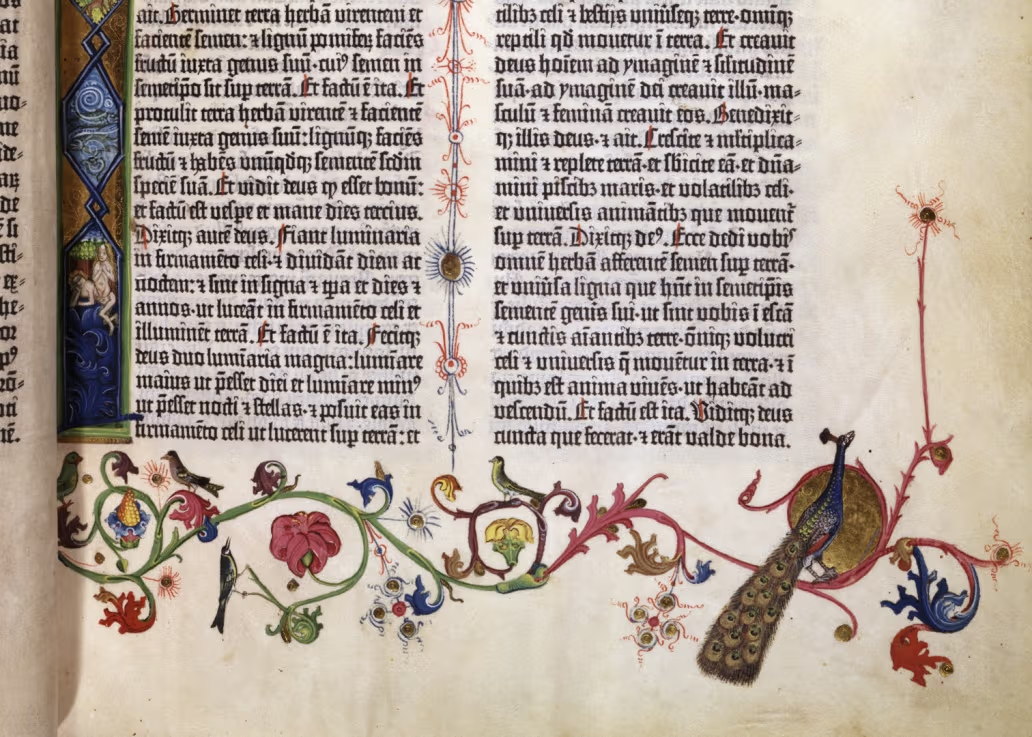
Johannes Gutenberg did not kill God, but he did kill the Catholic Church. Or at least its centuries-long monopoly on power in Europe. Before the printing press hit the scene in 1440, a single Bible took a scribe roughly three years to copy by hand, and cost the equivalent of a laborer’s lifetime earnings. The scarcity was not incidental. The fewer Bibles in circulation, the more essential the priest who could read the one chained to the pulpit like a pen at the bank. When Gutenberg’s invention reduced the cost of a Bible by 80% in a single generation, and when Martin Luther insisted it be printed in colloquial German rather than the canonical Latin, the priest’s role as the sole interpreter of divine text collapsed. Of course the Church didn’t actually disappear, but their authority migrated from almighty institution to demonstrated value. All of the sudden, you had to be a priest worth listening to if you wanted to impose influence. You had to be good at priesting. Most weren’t.
The same thing is happening right now. To strategy? No. But to strategists. Oh yeah. The industry of strategy remains hermetically sealed by choice, not necessity.
When a founder can spend a few hours prompting Claude or ChatGPT to understand their business, plug in some consumer data, and generate a brand positioning framework in 30 seconds, the monopoly on interpretation evaporates. The AI’s output will not be brilliant. But it will be competent if you do it right. And competency is the floor most strategists are already operating at. The median strategy deck is, and always was, just another guy staring at a sheep’s guts and making some educated guesses. A performance of expertise, divided into labeled regions, that let an institution’s leadership feel as if they had done their due diligence before making a decision they were probably going to make anyway.
A page from the Gutenberg Bible, the first book ever commercially printed. ca. 1455–1500.
The illegibility that justified the cult of strategy is now dissolving. The consumer is not really all that complicated. The culture is far from unreadable. Put in a modicum of effort to understand how strategic thinking works, and you can do it whether you’re a plumber or a PhD. The tools to interpret any market mystery are now available to everyone, the same way the Bible is. You can choose to turn to a supposed “expert” to read it for you. But you might discover it’s more enriching to do it yourself.
Reformation
The interpretive class has survived every previous disruption by retreating further into its own illegibility, adding more frameworks, more jargon, more livers with finer and finer regional subdivisions. That magic trick is now running thin. The monopoly on interpretation has been broken by AI the same way it was broken in 1440. Not by producing better priests, but by handing the congregation a new technology and encouraging them to read the text themselves.
The signs are already there for any strategist to read. McKinsey went from 17,000 employees to 45,000 during a decade of priestly expansion in the 2010s, then shed 5,000 the moment growth flatlined in 2025. In the same year, Omnicom swallowed IPG for $13 billion and immediately killed DDB, FCB, and MullenLowe, eliminating 10,000 agency jobs and counting. In 2024, prediction markets like Kalshi called the presidential election decisively while the pollsters were still insisting it was a toss-up, because it turns out people with money on the line are better haruspices.
“We make plans and God laughs.” — old Yiddish proverb.
What remains precious is what was always valuable in the first place: the capacity to translate interpretation into action. To plan, and then to do the damn thing, all in one workflow.
“Strategy” in its purest form was never true knowledge. It was an alibi. A six-figure permission slip. Now anyone with a laptop and some AI fluency can generate a competent plan in a few hours, if not minutes. The strategist who can also make things will survive the way the priest who could also build a school or run a hospital outlasted the Reformation. The executive who can write the strategy and then write the headline. The political consultant who can read the polls and then shoot the campaign ad. The military analyst who can map the threat landscape and then plan the operation. That person is dangerous, because nothing stands between the idea and its execution to sand down the edges.